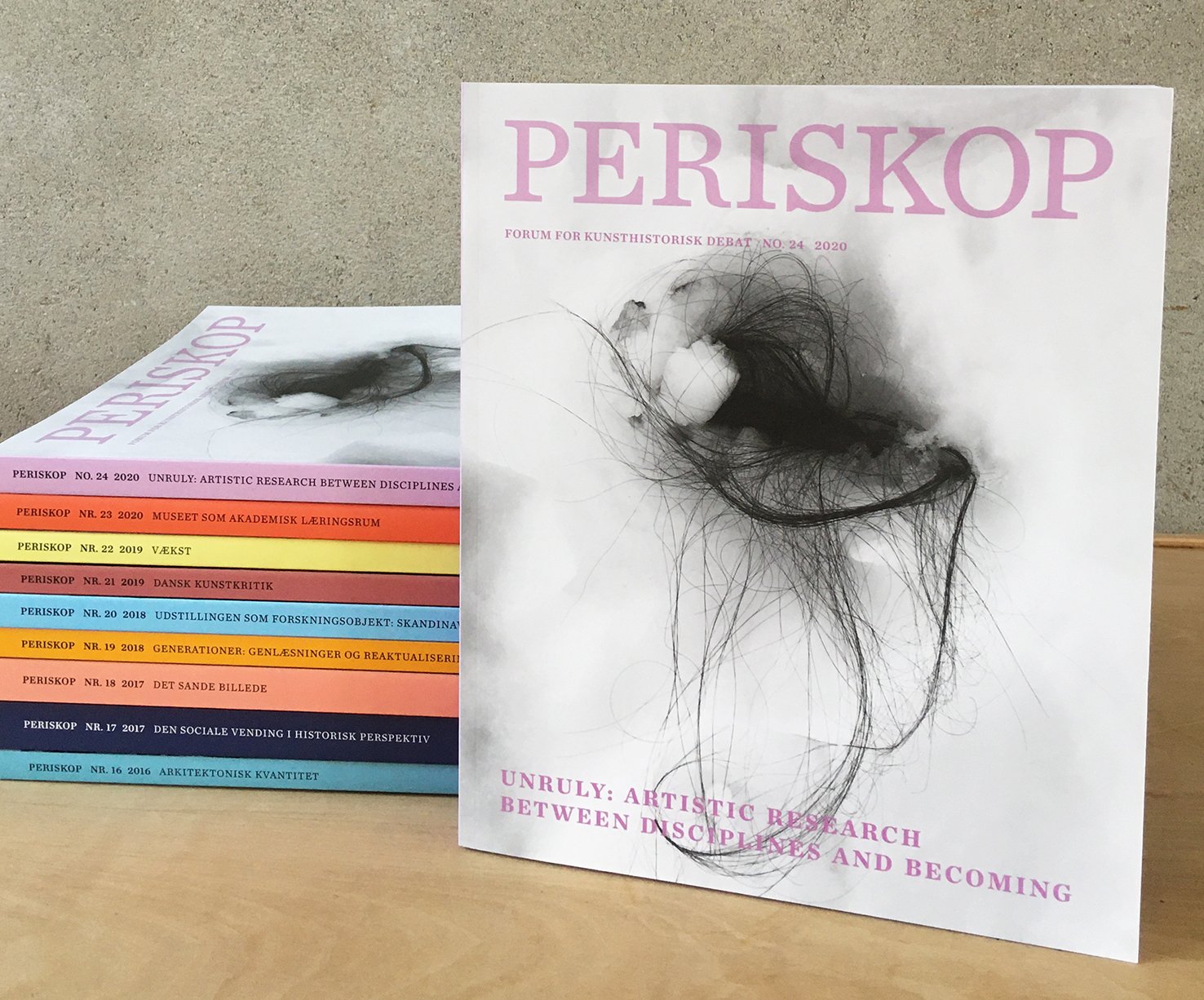
Unruly: Artistic Research between Disciplines and Becoming
By Katrine Dirckinck-Holmfeld, Charlotte Hauch, Camilla Graff Junior, and Lise Margrethe Jørgensen, 2020
Cover art work by Julie Edel Hardenberg
Contributors Julie Edel Hardenberg, Imayna Caceres, Lisa Nyberg, Nanna Lysholt Hansen, Christian Danielewitz, Maria Finn, Sofie Volquartz Lebech, Gry Worre Hallberg, Helen Eriksen, Gry O. Ulrichsen, Zahra Bayati, Katrine Dirckinck-Holmfeld, Charlotte Hauch, Camilla Graff Junior, and Lise Margrethe Jørgensen.
Graphic design Charlotte Hauch
Let me begin by saying that I came to theory because I was hurting, the pain within me was so intense that I could not go on living. I came to theory desperate, wanting to comprehend – to grasp what was happening around me. Most importantly, I wanted to make the hurt go away. I saw in theory then a location for healing.
bell hooks 1994
This special issue of Periskop arrives during a pandemic, as planetary cracks deepen and social injustices, structural and systemic discriminations, racism, sexism, trans- and homophobia, ableism, classism, inequalities, climate disasters, displacements, and wars continue to unsettle our present. In times like these, this special issue asks: How can we reclaim artistic research? And how are artistic research practices engaging in the co-creation of other worlds in response to different forms of social crises and planetary destruction? We open this volume with a quote by bell hooks, from her essay “Theory as Liberatory Practice” (1994), because, similarly to how hooks came to theory out of an urgency to relieve pain, we are turning to artistic research as a site for creating other forms of knowledges and to carve out spaces for experiences that have previously been excluded in response to this immense destruction.